Ocean Ridge Plantation Golf Review: 4 Courses for Every Type of Golfer
Four golfers. Four opinions. One wants the showpiece course with the sculpted landscaping and no houses in sight. Another wants the toughest layout you’ve got — sand waste bunkers, forced carries, the works. The third just wants a fair, traditional round where he can enjoy his morning without losing a sleeve of balls. And the fourth? He’s watching the budget. At most golf destinations, somebody compromises. At Ocean Ridge Plantation, everybody gets exactly what they asked for.
Four courses, four designers, four personalities — and you never leave the gates. Located in Ocean Isle Beach, NC, about 25 minutes from our condo at 601 Hillside Dr N, Ocean Ridge gives you 72 holes of variety that keeps every golfer in your group happy.
The Four Courses at a Glance
| Course | Designer | Character | Best For |
|---|---|---|---|
| Tiger’s Eye | Tim Cate | Upscale, sculpted, no houses | Special occasion rounds |
| Leopard’s Chase | Tim Cate | Tough waste bunkers, forced carries | Low handicaps, thrill-seekers |
| Lion’s Paw | Willard Byrd | Traditional, pine-lined, balanced | All skill levels |
| Panther’s Run | Tim Cate | Open, well-maintained, fair | Value seekers, casual rounds |
Tiger’s Eye: The Showpiece That Earns the Name
Tiger’s Eye is the crown jewel of Ocean Ridge, and from the moment you pull into the parking lot, you know this course takes itself seriously. Tim Cate designed it with the kind of obsessive landscaping you usually see at courses charging twice the green fee — flowering azaleas framing tee boxes, native wiregrass bordering waste areas, and almost no houses visible from any hole. For plantation golf, that’s rare. For Sunset Beach, it’s practically unheard of.
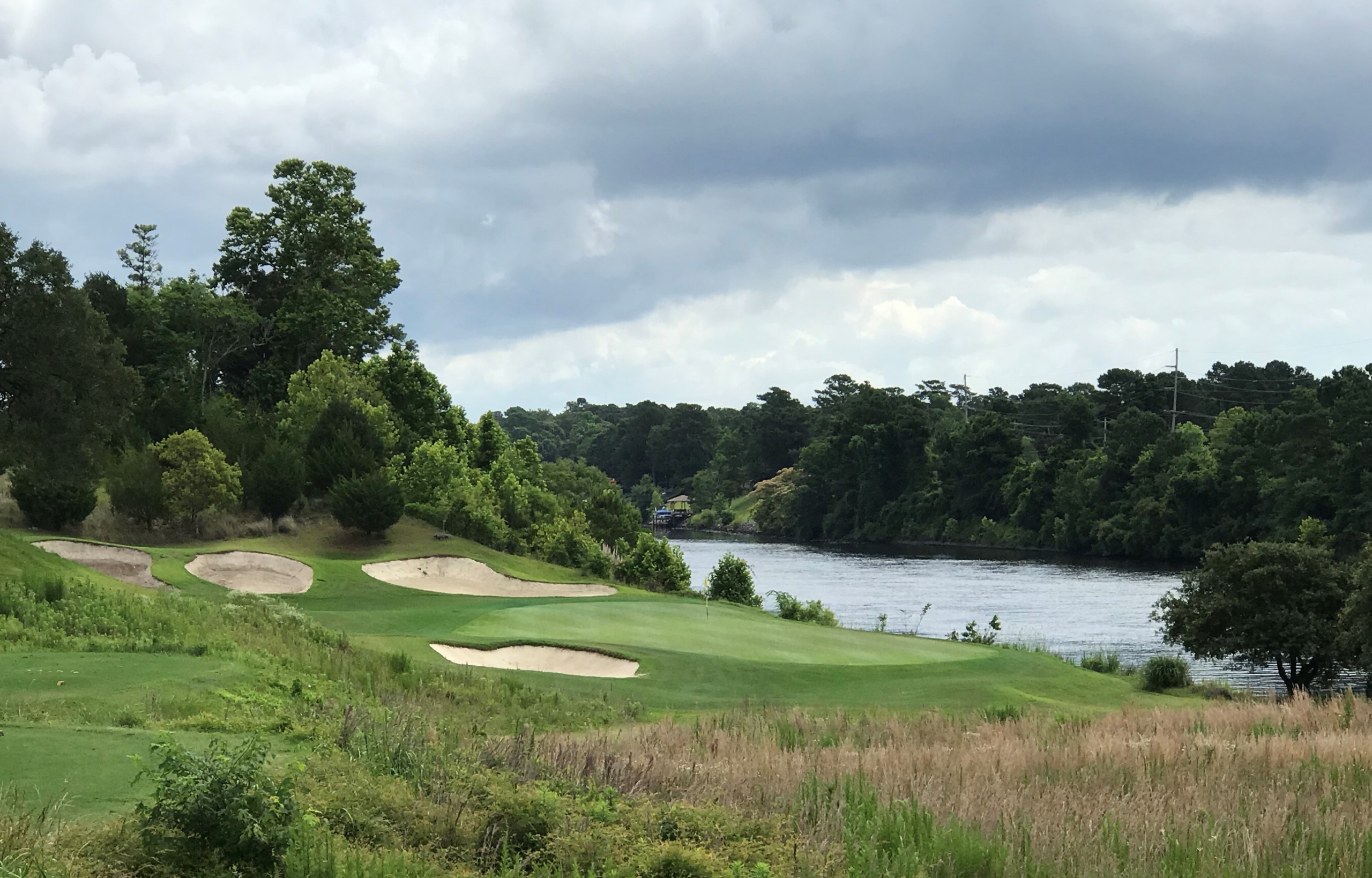
Hole 2 sets the tone immediately — a par 4 that plays from an elevated tee down into a valley framed by massive waste areas on both sides. The fairway looks like a ribbon from up there, and the morning light catches the sand in a way that makes the whole hole glow. Hit the fairway and your approach is into a green surrounded by Cate’s signature sculpted mounding. Miss the fairway and you’re standing in sand deciding whether to go for the green or pitch out. It’s a hole that photographs well and plays even better.
Hole 8 is a par 3 over water with a waterfall cascading behind the green. Yes, a waterfall on a golf course in Ocean Isle Beach. It sounds gimmicky until you’re standing on the tee with 165 yards of carry over the pond, the sound of water drowning out whatever your buddy is saying, and a green that slopes away from you toward the hazard. I’ve hit that green exactly in the middle and watched the ball trickle off the back edge twice. Now I play one club less and take the front of the green every time.
Hole 15 is where Tiger’s Eye shows its strategic depth — a par 5 that doglegs around a massive waste area. You can play it in three safe shots down the left side, or you can cut the corner over the sand and give yourself a shot at the green in two. The waste area is maybe 40 yards wide at the carry point, and there’s no bailout. I’ve seen guys hit heroic 3-woods to reach in two and I’ve seen guys hit heroic 3-woods into the sand. The green sits in a natural amphitheater of mounding, framed by live oaks, and the silence when you’re over a putt there is the sound of no traffic, no highway, no development — just Sunset Beach the way it was before they started building.
If you’re picking one course at Ocean Ridge for an Ocean Ridge Plantation golf review, Tiger’s Eye is it. Not because the others aren’t good — but because this one stays with you.
Leopard’s Chase: Where Ocean Ridge Shows Its Teeth
Leopard’s Chase is the course that separates golfers who want a challenge from golfers who say they want a challenge. Tim Cate designed it with more sand waste than any other course I’ve played on the coast — not the neat, raked bunkers you find at resort courses, but sprawling, natural-looking waste areas that border seemingly every fairway and frame every green like a moat.
The front nine lulls you. Hole 3 is a reachable par 5 with a generous fairway, and hole 6 is a pretty par 3 with water left that plays shorter than the card says. You might stand on the 9th tee thinking you’ve got this course figured out.
You don’t.
Hole 10 announces the back nine with a tee shot that demands a full carry over wetland to reach the fairway. There’s no lay-up option — you either clear 180 yards of marsh grass and standing water or you don’t. The sound of frogs goes quiet when you address the ball. Then hole 13, a par 4 with waste bunkers down the entire right side and a wetland carry on the approach — the green is tucked behind the hazard and the only way in is a committed mid-iron that holds the surface. A tentative swing here finds water every time.
Hole 16 is the one people talk about in the clubhouse afterward. It’s a par 4 that requires a tee shot over a waste area to a fairway that narrows to about 25 yards between sand left and marsh right. The approach is into a green with a false front that rejects anything short. I’ve played it six times and my best score is bogey. I’m not ashamed of that.
Fair warning: higher-handicap players may find the back nine genuinely frustrating. If your group is mixed, consider splitting up — the better players take on Leopard’s Chase while everyone else plays Tiger’s Eye or Lion’s Paw. Meet at the clubhouse afterward and let the Leopard’s Chase guys tell their war stories.
Lion’s Paw: The Course That Gets Better Every Time
Lion’s Paw is the original Ocean Ridge course, and Willard Byrd gave it the traditional layout that Tim Cate’s three courses deliberately avoided. Where Tiger’s Eye sculpts and Leopard’s Chase punishes, Lion’s Paw routes you through mature longleaf pines on a layout that feels like it’s been there for decades. The canopy is thicker here than on the other three courses, and on a still morning, the pine straw smells like you’ve stepped into a different climate entirely.
Hole 5 is a par 4 that doglegs gently through the pines, with the fairway dappled in shade and the green sitting in a sunlit clearing. The approach shot is the whole story — the green is slightly elevated and two-tiered, and if the pin is on the upper tier and you’re on the lower, that first putt is a prayer. Hole 12 is a long par 3 — 200 yards from the back tees — to a green guarded by deep bunkers on both sides. The tee shot plays through a corridor of pines, and the shadows make depth perception tricky. I play 5-iron there regardless of the pin because the bunkers are deep enough to cost you a full shot just to escape.
Hole 17 is Lion’s Paw at its best: a par 5 that plays downhill through the pines to a wide fairway, then bends right to a green surrounded by mounding. The second shot is the fun one — you can see the green from 240 out, and the downhill slope adds 20 yards to whatever you hit. It’s the hole where bogey golfers make pars and single-digit guys make birdies, and everyone walks off smiling.
Think of Lion’s Paw as the round that makes everyone in the group happy. It won’t humble you the way Leopard’s Chase will, and it doesn’t have the visual drama of Tiger’s Eye, but it delivers 18 holes of honest, enjoyable golf where the biggest challenge is your own game.
Panther’s Run: More Than the Budget Pick
Panther’s Run gets treated as the afterthought at Ocean Ridge, and that’s not fair. Yes, it’s usually the most affordable of the four. But Tim Cate still designed it, and when you’re standing on the tee at hole 7 — a par 4 with a sweeping dogleg right around a pond, the fairway tilting toward the water the whole way — you’re not thinking about the green fee. You’re thinking about whether your fade can hold the fairway or whether it’s going to catch the slope and run into the hazard.
The course plays more open than the other three, with wider fairways and fewer trees crowding the landing zones. That makes it friendlier off the tee, but Cate compensated with green complexes that demand precision on the approach. Hole 14 has a green with a ridge running through the middle — if the pin is front and you’re on the back tier, you’re three-putting. Period. It’s the kind of subtle design feature that doesn’t show up in the course description but absolutely shows up on the scorecard.
Panther’s Run is the round I recommend for day three or four of a trip, when your legs are tired and your swing is looser than it was on day one. The wider fairways forgive the late-trip mishits, and the price point means nobody feels bad about a blow-up hole. But play it once and you’ll understand why regulars choose Panther’s Run for their after-work nine — it’s comfortable golf in the best sense of the word.
Course Details at a Glance
- Location: 351 Ocean Ridge Pkwy SW, Ocean Isle Beach, NC 28469
- Holes: 72 (four 18-hole courses)
- Designers: Tim Cate (Tiger’s Eye, Leopard’s Chase, Panther’s Run), Willard Byrd (Lion’s Paw)
- Price Range: Varies by course — Tiger’s Eye highest, Panther’s Run most affordable
- Drive from 601 Hillside Dr N: ~25 minutes
Tips for Playing Ocean Ridge
- Start your trip with Tiger’s Eye. It’s the best course on the property and gives you the strongest first impression of what Ocean Ridge is about. The waterfall hole (#8) alone is worth the green fee.
- Match skill levels to courses. Send your best players to Leopard’s Chase — they’ll love the back nine war stories. Let higher handicaps enjoy Tiger’s Eye or Lion’s Paw without the frustration of forced carries over wetland.
- Book a multi-course package. Playing two or more courses at Ocean Ridge usually unlocks better per-round pricing, and you’ll want to play at least two to understand the range of what’s here.
- Respect Leopard’s Chase holes 10, 13, and 16. If you’re on the fence about your game, the front nine is manageable — it’s those three holes that separate the confident from the cautious. Extra balls in the bag. No shame in that.
- Combine with nearby courses. Ocean Ridge is in Ocean Isle Beach, so you’re close to Thistle, The Pearl, and Sea Trail for mixing up your rotation across a multi-day trip.
Who Should Play Ocean Ridge?
Golf trip groups — full stop. The four-course format is tailor-made for multi-day trips where you want variety without driving all over the Grand Strand. A group can play a different Ocean Ridge course each day and get four completely different experiences: the showpiece, the grinder, the classic, and the value play.
It’s also the answer for groups with varying handicaps. Instead of forcing everyone onto the same course and watching the 25-handicapper suffer through Leopard’s Chase hole 16, you split up. The competitive guys take on the waste bunkers and forced carries. The social golfers play Tiger’s Eye and come back talking about the waterfall and the landscaping. Everyone reconvenes with a different story, and nobody had to compromise.
Want to mix Ocean Ridge days with courses from other parts of the Grand Strand? Our golf course guide covers every top course near North Myrtle Beach. And for the big picture – when to come, what to bring, how to structure your days – the trip planning guide has it all.
Four Courses Behind One Gate — and a Condo Where Every Golfer Gets What They Wanted
The beauty of Ocean Ridge is the argument that never happens. The showpiece-seeker plays Tiger’s Eye and comes back raving about the landscaping. The grinder tackles Leopard’s Chase and comes back humbled by the back nine. The traditionalist plays Lion’s Paw and comes back satisfied. Everyone reconvenes at 601 Hillside Dr N in Ocean Keyes — about 25 minutes from Ocean Ridge — with three bedrooms, a full kitchen, and enough space for four different post-round stories to unfold at once. That’s the kind of golf trip where nobody compromises.
Check Availability & Book Your Stay
I’ve played all four Ocean Ridge courses and I know which one fits which golfer. Tell me about your group and I’ll build the lineup.

Add Comment